Working for a Lifetime at Sprague
What became an internationally-renowned company based in the Berkshires started as the work of just three people in the kitchen of a home in Quincy, MA more than ninety years ago.
Text
In 1926, Sprague Specialties Company was run by Ensign Robert C. Sprague, his wife, Mrs. Florence Sprague, and Mary E. Avery – Molly, to her friends. Sprague Specialties – later to be called Sprague Electric – grew rapidly from a family business to a company known worldwide, and workers like Molly continued at their jobs for decades as the business changed around them. Like many industrial companies, Sprague flourished during the Second World War; sales were up, and employment was at a record high. But what made Sprague exceptional was not the number of its employees, but their loyalty; in 1943, there were seventy-five three-generation families on payroll.
Molly Avery worked at Sprague Electric for thirty-five years as the company’s first paid employee, as well as acting as a secretary for Robert C. Sprague, the first company president. Etta Owen was the company’s medical supervisor for twenty-six years, 1938 to 1962. Elsie Manson worked as a nurse for forty years, nearly half the company’s lifespan. It was incredibly common for workers to spend decades at Sprague, largely in part to the familial atmosphere which the company worked to foster. So strong was worker loyalty that even decades later, workers fondly remembered their time there despite long hours for pay that was low and slow to increase; in 1940, women were paid fifty cents an hour; one dollar an hour in the 1950s, and increased two dollars an hour by the late 1960s. Women were paid at least ten percent less than men working the same jobs during different shifts. Furthermore, the work environment at Sprague began to change as the decades passed.
Workers like Avery and Owen had seen Sprague grow into something far beyond anyone’s initial expectations – good for the company, but not necessarily for the workers. When asked, workers stated that the friendly atmosphere and feeling of community began to change, perhaps in the sixties as new policies meant to increase productivity were introduced, or perhaps during the war – but definitely with the “gradual regimentation of the workplace.” Still, employees were loyal to the company, to the point where the company could lay off workers only to have them come back looking to be rehired later: Ann Thibert lost her job as a supervisor in the sixties, came back to be hired as a low-level technician, only to be fired again in the late eighties. Hers was not the only case of such events. Yet even through strikes and economic ups and downs, the feeling of a Sprague ‘family’ remained, all the way to the company’s eventual close, and lingering for years after.
Files
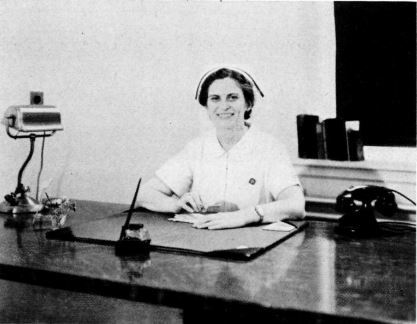
Etta Owen.
Etta Owen, who worked from October 1936 to August 1962 as Medical Supervisor of Sprague Electric. She trained at four different hospitals over several years, and in June of 1938 treated more than six hundred injuries at the company. | Source: Sprague Log Vol. 1 No. 1. 1938.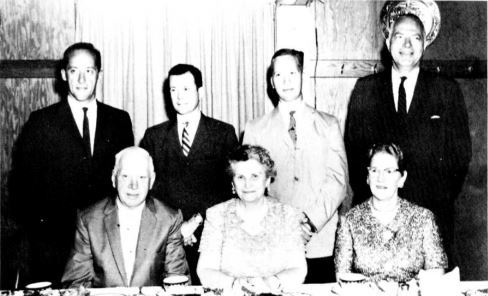
Etta Owens Retirement Party.
Etta Owen, center, front row, at her retirement dinner in 1968. On her left is Dr. William G. Heeks; her right, Agnes Costello. Back row, left to right: John H. Winant, Robert C. Sprague, Kenneth S. Brown, John D. Washburn. Etta was a part of Sprague’s Quarter Century Club, which honored workers who had been with the company for more than twenty-five years. | Source: Sprague Log. Vol. 24 No. 12. 1962.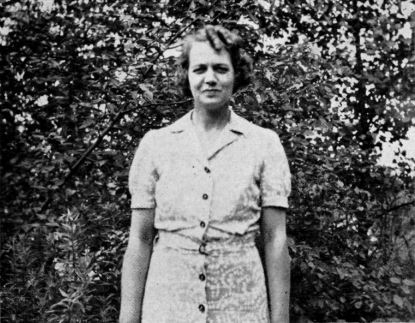
Mary "Mollie" Avery
Mary “Mollie” Avery, Sprague’s first paid employee. She took over doing paperwork from Mrs. Florence Sprague as the Spragues started what would grow to be a major company from the basement of their home. She also served as a personal secretary to Robert C. Sprague for thirty-five years. | Source: Sprague Log. Vol. 1 No. 1. 1938.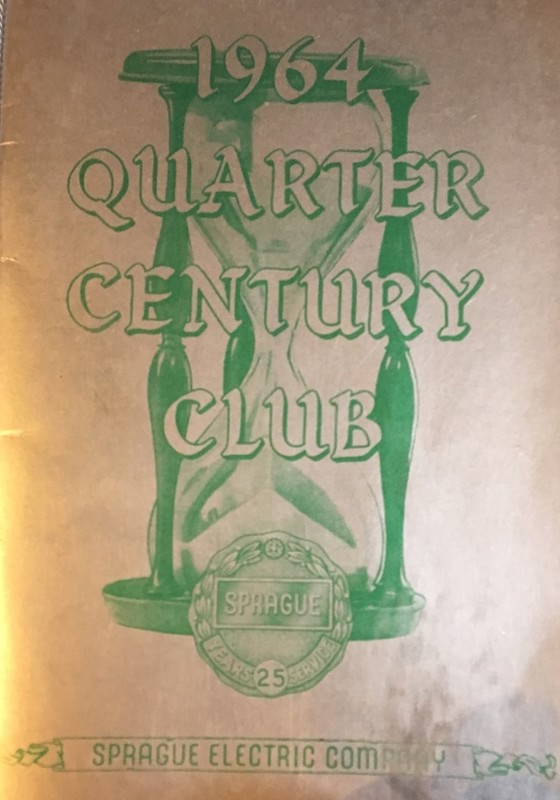
Booklet celebrating the Quarter-Century Club.
The cover of a booklet printed by Sprague Electric for their quarter-century club and award ceremony. Inside are photos of those who had served with Sprague for twenty-five years as of 1964, a letter written by Robert C. Sprague, and the names of others who had already been inducted, with indicators saying if they were retired or deceased if either applied. | Source: Courtesy of the North Adams Historical Society.